Product · project hours
Project-based time tracking
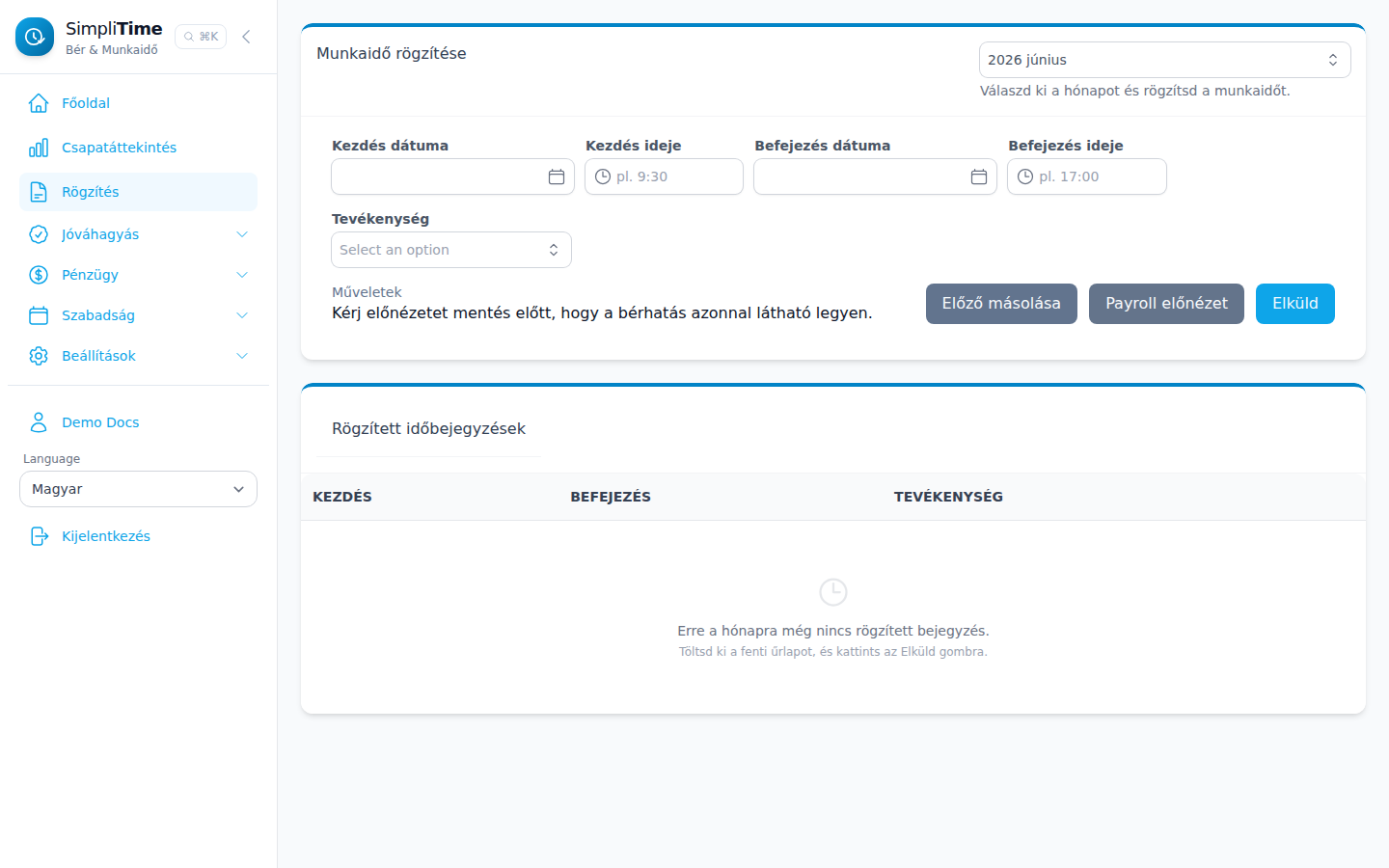
When the question is not how much someone worked but what they worked on, a daily attendance sheet is not enough. In SimpliTime, working time can be recorded by project and activity — in the same system that handles leave, overtime and the monthly close.
Why this needs its own page
Most Hungarian time tracking systems handle the day: when you started, when you finished, how long the break was. That is enough on a production line, but not at an agency, engineering firm or software company, where the question is not how much someone worked but on what.
In SimpliTime, project-level recording is not a separate module but a dimension of the same time entry. In practice that means hours booked to a project go through the same approval and the same monthly close as all other working time — they do not live in a separate spreadsheet that nobody reconciles with the attendance sheet at month end.
What it does
- Project and activity breakdown. Employees record their working time against a project and, within it, an activity.
- Per-project approvers. You define who approves the hours booked to each project — including the order of approvers.
- A separate approval view. Project-based approval has its own screen, rather than being buried in the per-employee list.
- Monthly project report. Approved hours can be reviewed per project, broken down by month.
- Hourly rate per activity. Rates can be recorded per employee and activity, with a validity period — earlier months keep the earlier rate.
- Project in the export. Project code and name can be added as export columns, and reports can be filtered by project.
Who can see project data
This question becomes sharp quickly in consulting and agency work, because project hours are also performance data. Access opens through two routes:
| Role | What they see |
|---|---|
| User with project management rights | Approved hours on every project |
| User registered as an approver on a project | Only that project's hours |
| Everyone else | Not the project's aggregated data |
A project lead does not automatically gain visibility into other projects by being an approver on their own.
One month of project-based operation
- Set up projects and activitiesA project gets a code and a name; activities define the breakdown you will want to analyse later. It is worth starting with few, clearly distinct activities.
- Assign approversPer project, you define who approves the hours and in what order. This is where it is decided who gets the question at month end.
- Daily recordingEmployees record time against a project and activity. This step needs habit-building, not technology.
- Approval per projectThe project approver reviews the hours booked to it. Discrepancies surface here, not at invoicing.
- Monthly close and exportAfter the close the data is fixed and can be exported together with the project code.
Who it fits — and who it does not
A good fit if…
- you are a services, engineering, IT or consulting company where hours belong to projects
- project hours currently live in a separate spreadsheet, detached from the attendance sheet
- project hours need to be approved, not just recorded
- Hungarian labour-law compliance (leave, overtime, monthly close) is also a requirement
- payroll and controlling should work from the same data
Look elsewhere if…
- project budget tracking and effort forecasting are the main need
- invoices should be generated directly from the hours
- client-level profitability reporting is the goal
- you need task and resource planning rather than hour accounting
- you expect automatic, application-usage-based time measurement
Set up two projects and run one month
Project-based recording shows its value when a real month goes through it: recording, per-project approval, close, then export with the project code included.
Start the 60-day trial